Dwarf Mugo Pine Care Tips: Keep Your Pinus Mugo Variety Pumilio Thriving Year-Round

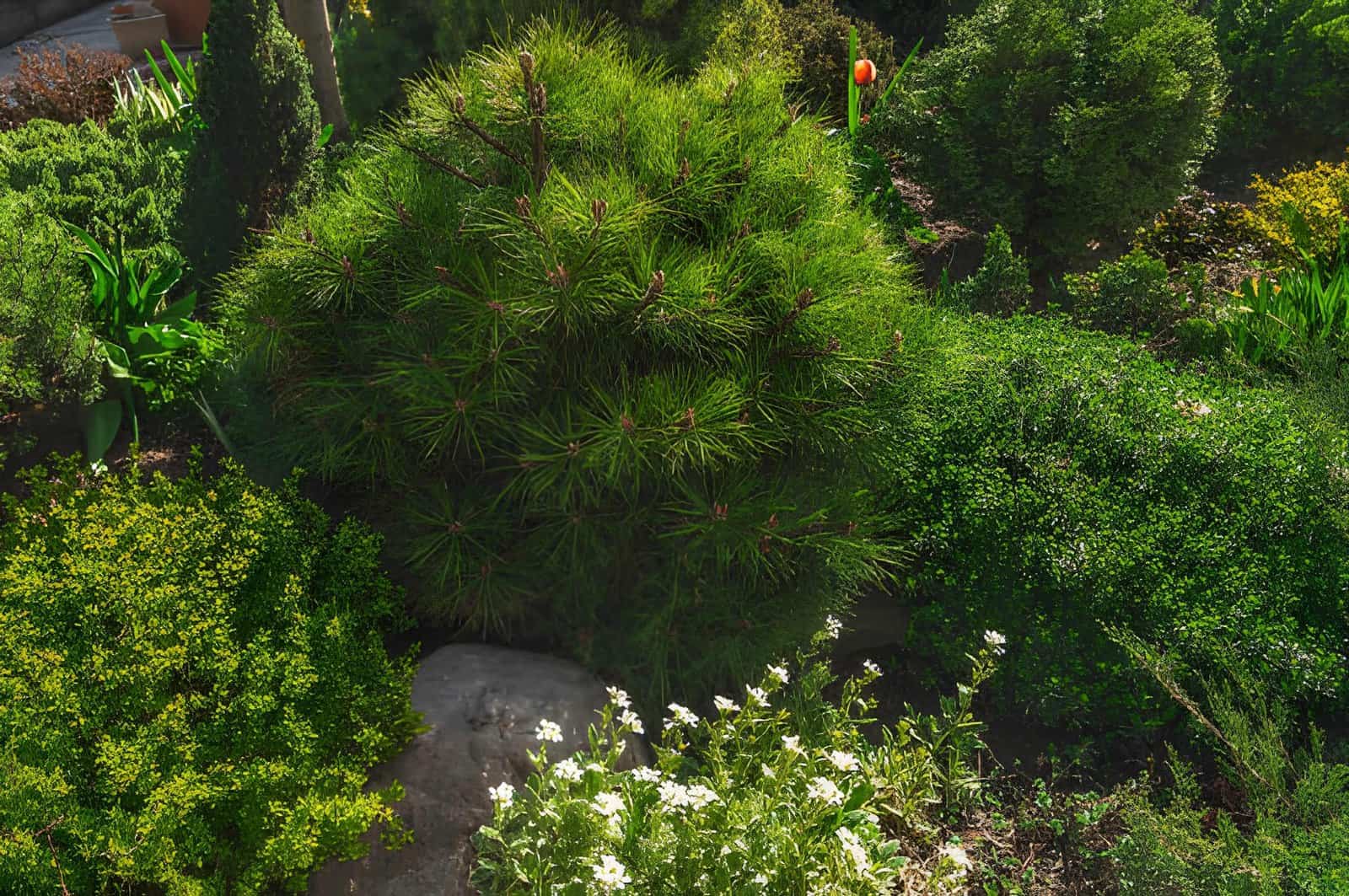
The Dwarf Mugo Pine, otherwise known as the Pinus Mugo variety “Pumilio” or Dwarf Mountain Pine, Dwarf Pine’, Drooping Cone Pine’, Mountain Pine, Swiss Mountain Pine, Mugo Pine, is a rather well-known shrub by green thumbs’ around the world.
Best known for its low maintenance and slow growth, this shrub will likely liven up your house (or garden) with its dark green colored leaves. But, only if you learn how to take proper care of it for it to thrive.
Fortunately, this is exactly what we’ll cover in this Dwarf Mugo Pine Care Guide. So let’s dive in.
But if you prefer to watch a short video instead, check it out here:
In order to take proper care of your Dwarf Mugo Pine you’ll need to keep in mind the following guidelines:
- Water: The Dwarf Mugo Pine needs at least weekly watering, or more in extreme heat, preferably with regular water.
- Light: Keep your Pinus Mugo “Pumilio” in an environment where it can receive full sun on a daily basis.
- Soil: Make sure to keep the Dwarf Mugo Pine in soil with well-draining properties, so ideally, one that is made of clay, loam, chalk, and sand.
On top of these three plan care fundamentals, we have summarized other important aspects below:
| Name | Dwarf Mugo Pine (Pinus Mugo) |
| Family | Pinaceae |
| Water | ∼2 times per week |
| Light | Full sun |
| Temperature | As low as -50°F |
| Humidity | Tolerates both dry and humid air |
| Where to buy | Etsy |
Description and Botanical Aspects
In botanical terms, the Dwarf Mugo Pine belongs to the Pinaceae family, the genus Pinus and the species Mugo, hence its scientific (or botanical) name Pinus Mugo “Pumilio” (PY-nus MEW-goh). Other common Pinaceae species include Pinus Mugo ‘Sherwood Compact’, Pinus Contorta Var. Contorta, Dwarf Blue Rocky Mountain Fir, Pieris Japonica Purity, Horstmann’s Silberlocke Korean Fir, Lantana Camara ‘Monike’ Plant Patent #17,612, Photinia X Fraseri, Picea Mariana ‘Nana’, Pinus Flexilis ‘Vanderwolf’S Pyramid’, Pinus Sylvestris ‘Glauca Nana’, Loblolly Pine,
As with other Pinus, the Dwarf Mugo Pine is an evergreen plant, which means it will be present year-round in your garden.
Growing Region
The Dwarf Mugo Pine, also known as Pinus mugo ‘Pumilio,’ is native to the mountainous regions of Central and Southern Europe. In its natural habitat, it thrives in cool, open landscapes with well-drained soil and fresh air. Understanding this origin helps gardeners create similar conditions at home for stronger, healthier growth.
Replicating its native environment is one of the best ways to keep this compact evergreen thriving year-round. Since it evolved in rugged climates, the Dwarf Mugo Pine adapts well to cold temperatures and changing seasons.
| Feature | Ideal Range |
| Native Region | Central & Southern Europe |
| Heat Zones | 1–7 |
| Hardiness Zones | 2a–9b |
| Climate Zones | 1–24, A1–A3 |
For best results, provide:
- Full sun exposure
- Well-drained soil
- Cooler to moderate climates
With the right setting, this hardy pine becomes a reliable and attractive landscape plant.
Growth and Size
Growth
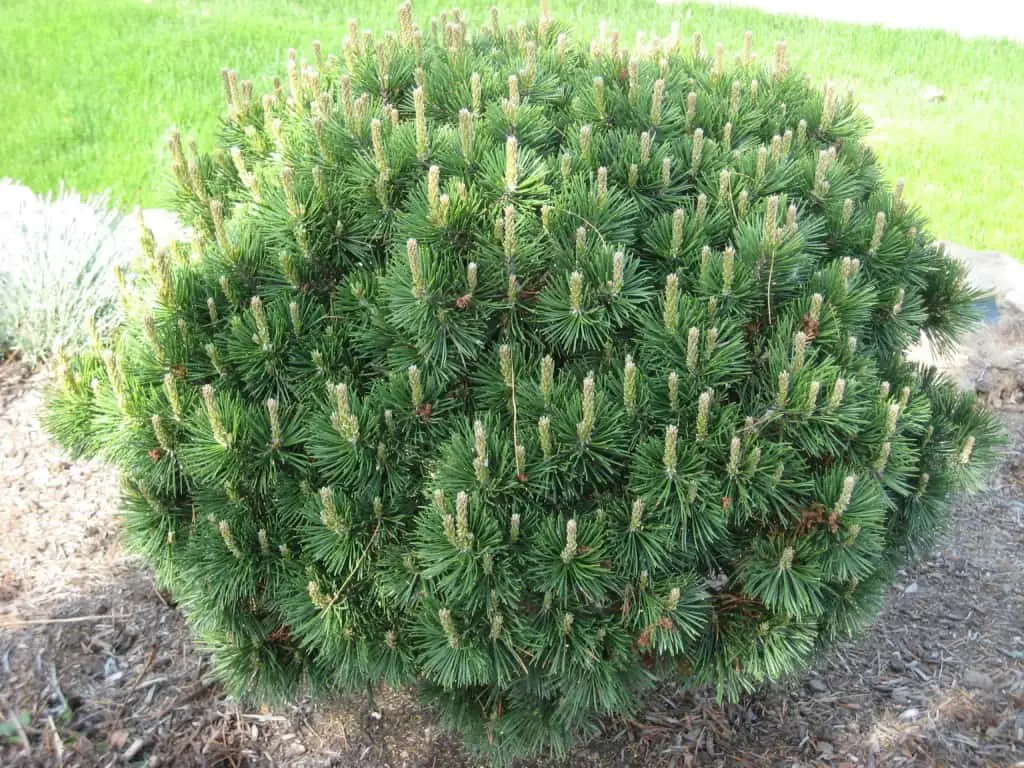
In terms of size and growth, the Dwarf Mugo Pine is a relatively slow grower, which makes things easy for any plant enthusiast.
Size
But what exactly does this mean for your Dwarf Mugo Pine? How large a pot should you consider, how tall, how wide can it get? Let’s jump in…
The Dwarf Mugo Pine can grow up to 3′ – 5′ (90cm – 150cm) tall and 6′ – 10′ (180cm – 3m) wide.
These dimensions make the Dwarf Mugo Pine a relatively large shrub compared to others, so it’s best to keep this fact in mind since it will affect where you want to keep yours at home.
This is why experts recommend keeping an area of approximately 120″ (300cm) free so the Dwarf Mugo Pine can spread to its best extent.
Watering
In terms of watering, the Dwarf Mugo Pine is a fairly simple plant to take care of. This is mostly because it has a pretty straightforward watering schedule and somewhat regular watering needs.
Specifically, most experts agree that the Pinus Mugo “Pumilio” needs at least biweekly watering, or weekly more in extreme heat, preferably with regular water.
This is why it is considered a plant with relatively average needs in terms of water. As a rule of thumb, you should remember to keep your Dwarf Mugo Pine in soil with well-draining characteristics, as these will guarantee the right conditions for your plant to grow and thrive.
When you consider this, this is why you should aim to choose soil that has good drainage properties to keep the right moisture levels at all times.
In our experience, the famous ‘thumb’ or ‘finger’ test is what works best for the Dwarf Mugo Pine since with it, you will be able to give it the right amount of water, every time – regardless of the environment or placement where you do decide to keep it.
Soil Mix
As mentioned earlier, the Dwarf Mugo Pine prefers to have soil with good drainage properties at all times, reason why you need to make the soil mix out of clay, loam, chalk, and sand.
This is why most experts agree that the Dwarf Mugo Pine requires soil with loam (silt), and sand, which will give you the right conditions it needs.
In addition to this, expert gardeners recommend having preferably alkaline, acid or neutral soil.
Do Mugo Pines need full sun?
In terms of light & exposure, the Dwarf Mugo Pine requires full sun in order for it to thrive under the right conditions.
Most experts agree that this shrub will do well as long as you keep it in full sun, and it will be able to grow properly.
Specifically, we recommend that you place your Pinus Mugo “Pumilio” in little to partial shade (only 2-6 hours of direct sunlight a day), to full and direct sun (more than 6 hours of direct sunlight per day).
Season
As an evergreen conifer, the Dwarf Mugo Pine keeps its rich green foliage throughout the year, making it a dependable feature in any landscape. Unlike seasonal plants that fade or go dormant, this hardy pine provides structure, texture, and color in every season.
Its peak visual appeal stretches across nearly the entire year, especially during active growth periods in spring and summer. Even in colder months, it remains vibrant and attractive.
| Season | Performance |
| Spring | Prime growth and fresh new shoots |
| Summer | Full, healthy foliage |
| Fall | Consistent evergreen color |
| Winter | Strong structure and year-round beauty |
What makes it stand out:
- Evergreen presence in all seasons
- Excellent cold-weather resilience
- Decorative value even in winter
This makes the Dwarf Mugo Pine a reliable choice for gardeners who want lasting beauty without seasonal
Foliage
The leaves from the Dwarf Mugo Pine have a beautiful dark green color during most of the year.
In particular, like most other pines, it has its famous needle arrangement in its leaves to preserve water in dry conditions.
Most pines are evergreen, meaning they retain their needles throughout the year. However, Mugo pines are one of a few species of pine that lose their needles in the fall. The bark on a mugo pine is also thin and scaly, which makes it susceptible to pests and diseases.
Pest and Diseases
One of the most common pests that attack Mugo pines is the pine sawfly. Sawflies are tiny yellow-green insects that lay their eggs on the tips of new pine needles. When the eggs hatch, the larvae (young sawflies) start to eat away at the needle, eventually killing it.
Another common pest that attacks Mugo pines is the pine bark beetle. Pine bark beetles are small black. Sawflies can be controlled with insecticides, while pine bark beetle can be controlled by removing infested branches and spraying an organic pesticide.
| Check out: Pinus Strobus ‘Nana’ (Dwarf Eastern White Pine) Care and Growing Guide |
Attracts, Tolerance and Resistance
The Dwarf Mugo Pine is well known for its tolerance to dry soil, drought and animals like deer, so don’t worry if any of these come along, your Pinus Mugo “Pumilio” will be fine.
Garden
Does your Dwarf Mugo Pine have any garden recommendations? Does it serve any gardening purposes? Here’s how you can get the most out of your new plant.
Most Pinus Mugo “Pumilio” owners agree that this shrub will look great in most contemporary, asian/zen and rustic gardens of all types.
Other owners consider that they complement well most gardens of informal and cottage, coastal garden, gravel and rock garden, and in traditional garden styles.
In particular, the Dwarf Mugo Pine’s best location within your garden is in beds and borders, others use it for landscaping in a specimen, wildlife garden, border, rock garden, urban garden, topiary, mass planting, container, or a woodland garden.

Companion Plants
Dwarf Mugo Pine’s do well with some other plants beside it. One good companion plant is the Acer, which will pair up nicely with your leafy friend. Others consider that a nice Ilex will work well too, so choose whichever you find works best for you!
Conclusion
So that’s it! These are the main plant care requirements that you need to keep in mind in order to have a healthy Dwarf Mugo Pine in your garden or home.
Related Questions
Can a Mugo Pine be transplanted?
Yes. Mugo pine can be transplanted successfully as long as you take some preventative measures:
- First, make sure to water the tree deeply the day before you transplant it.
- Second, be gentle with the roots when removing them from the soil and replant them in the new location.
- Finally, make sure to pack the soil tightly around the roots and water thoroughly. Your mugo pine should thrive in its new home if you follow these steps.
Can you prune a Dwarf Mugo Pine?
Yes, you can prune a Dwarf Mugo Pine. The best time to do so is in late winter or early spring before new growth begins. Make sure to use sharp clippers and disinfect them between cuts with alcohol or bleach to prevent the spread of disease. Remove any dead or damaged branches, then cut back the remaining branches by about one-third.
What are the main types of Mugo Pine?
There are five main types of Dwarf Mugo Pine: Compacta, Sherwood Compact, Enci, Gnome, and Mops. Each has its own unique set of characteristics that make it ideal for different applications.
Compacta stands out due to its dark green needles and can grow up to four feet tall and between two to four feet wide.
Sherwood Compact is a slow-growing dwarf pine tree densely needled and has a compact shape. It is native to the mountains of central and southern Europe and grows best in cool, moist climates.
Enci is a cultivar that is notable for its short needles. It grows best in USDA Zones 2 through 7. This conifer is native to the mountainous regions of Central Asia.
Gnomes are typically 18 to 24 inches tall and 3 feet wide. They have a flat-top form and a dense, upright, conical shape. USDA zones 4 through 8.
Mops is a decorative tree that is typically four feet tall and two to three feet wide. They can grow up to 30 years old and prefer confined spaces. Their soft needles make them a popular choice for Christmas trees.